De Novo Design of Progressable Antibodies to Therapeutic Targets
Summary
Fulfilling the promise of AI to accelerate the discovery of new medicines requires showing that it can lead to more rapid creation of drug leads or the drugging of targets that have been refractory to other approaches. This post reports the success of our AI molecular design model, X-Design, in both tasks.
Introduction
Since the first demonstration that de novo design of antibodies with epitope specificity and therapeutic affinity is possible[1], the field has made rapid progress, with several groups reporting de novo binders with high hit rates and affinities to specific epitopes — albeit in many cases against targets and epitopes that were already well characterized and well served by traditional methods.
For de novo antibody design to have therapeutic impact and meaningfully supplement or supplant traditional antibody discovery, at least one of two capabilities has to be demonstrated:
- It must be faster or cheaper than traditional approaches on real therapeutic targets — can a single design pass yield a fully progressable binder[2] (human, potent, selective, cross-reactive, and developable) against a desired epitope?
- It must enable discovery where traditional approaches fail — can design succeed on a target that has already resisted both traditional and prior computational methods? GPCRs are a useful illustration: while some GPCRs with clear, accessible epitopes have proved amenable to traditional antibody discovery and have become case studies for AI-based approaches, many GPCRs lack such properties and have remained recalcitrant to antibody discovery or design until now.
Here we show that X-Design, our AI for molecule design, demonstrates these capabilities using two program targets from Xaira’s pipeline: XA-1, a campaign on a defined epitope focused on lead speed and quality, and XA-4, a complex GPCR target where prior display and immunization efforts have failed. X-Design was built using a combination of public and proprietary data that we have expanded and improved over the past several years. In our previous post[2], we underscored the concept of a progressable binder and described the three questions a candidate must answer in sequence. The Vega class of X-Design models, highlighted in this post, optimizes simultaneously for properties like these — human, potent, selective, cross-reactive, and developable — rather than designing simply to generate binders. This requires balancing binding with humanness and developability, properties that can require trade-off, as shown previously[2]. By incorporating proprietary data, we aligned the Vega class of X-Design to our definition of progressable binders to better navigate this trade-off (Figure 1A).
X-Design Vega is a general-purpose model for molecule design, and the molecules designed below were generated zero-shot – no data from previous campaigns was used to train the model. Our goal here is to illustrate, through these two case studies, how X-Design is helping change the practice of drug discovery. A systematic assessment of X-Design will be provided in a future post.
Better Molecules, Faster with X-Design
XA-1 is Xaira’s lead oncology program that requires binding a precision-constrained epitope selective for the target over closely related family members, being cross-reactive to the homologous protein in surrogate species, and having an affinity within a specific window. In addition, it needs to have all the other properties of a progressable binder in order for this molecule to be useful therapeutically.
We evaluated whether X-Design could produce a molecule with these characteristics directly, and how many steps would be required to reach a lead. We used X-Design Vega to design 182 VHH sequences de novo against a specific epitope of the target, chosen for its functional outcomes and cross-reactivity in surrogate species. We then screened them using Surface Plasmon Resonance (SPR) against human and surrogate targets, followed by PAIATM OVA, Heparin, Cation, and HIC assays, Baculovirus Particle (BVP) assay, and the nanoDSF assay.
Initial screening identified 25 hits, with 18 confirmed binders (10% binder rate) after full QC filtering, and 9 yielding high-quality kinetic fits.
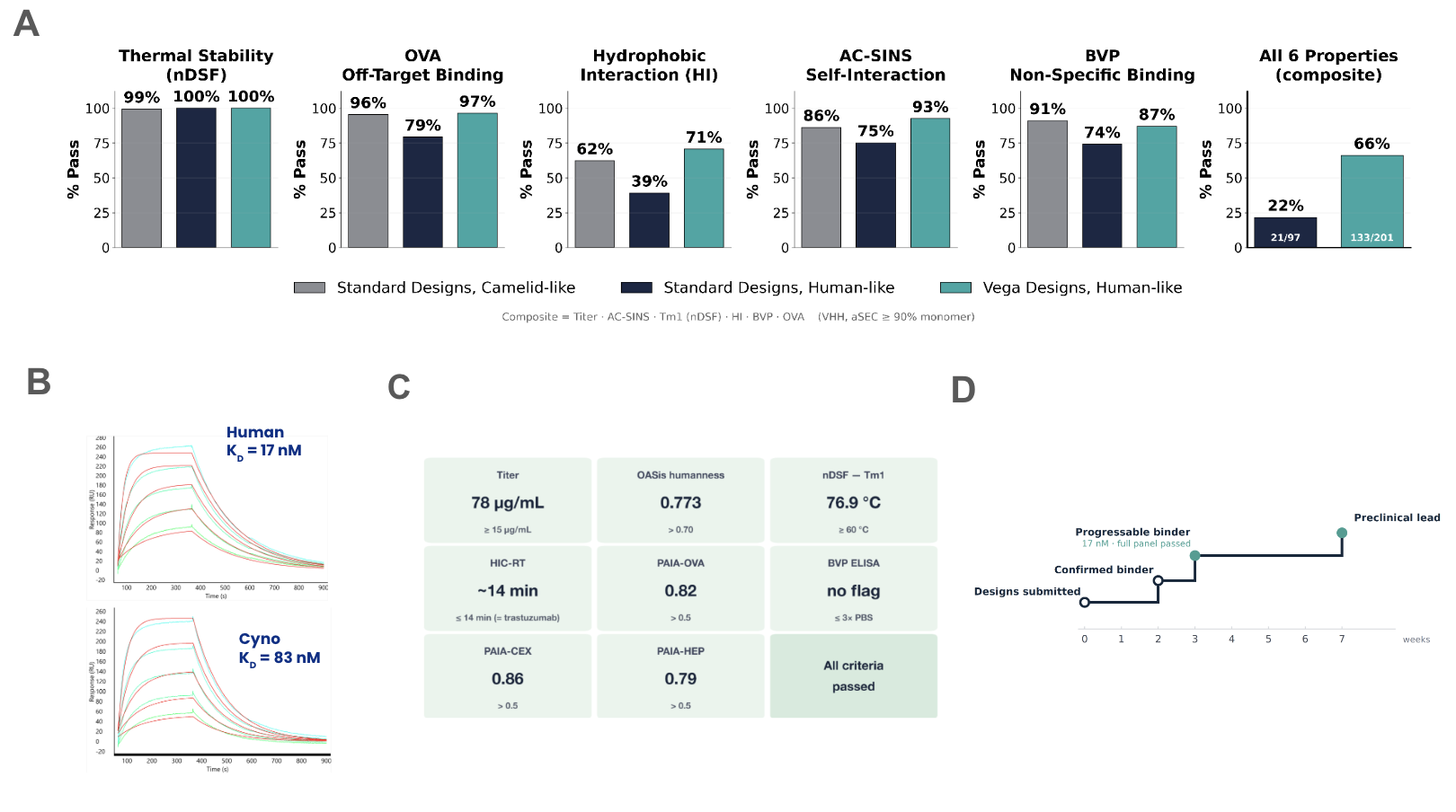
Figure 1: X-Design Vega triples (A, rightmost panel) the rate of human-like VHH sequences that meet all developability criteria (cyan) over a baseline model that was trained without proprietary data (blue) The affinity of the best molecule to human and cynomolgus variants of the XA-1 target protein are 17 nM and 83 nM respectively (B). The best molecule passes all the developability criteria for a progressable molecule (C). The entire experimental process from start to a lead molecule took 7 weeks for XA-1 (D): three weeks to get the progressable binder shown in (B, C), followed by one round of optimization for surrogate species cross-reactivity.
The best binder had a KD of 17 nM against the human target and 83 nM to the cross-reactive surrogate, successfully passing all developability metrics (PAIA-OVA, CEX, HEP, BVP, thermal stability, HIC retention time) with a high OASis score as shown in Figure 1B-C, qualifying this binder as progressable. One additional optimization round enhanced surrogate cross-reactivity to yield a preclinical lead.
In this campaign, the design step directly produced a progressable molecule that was simultaneously human-like and developable in 3 weeks of wet lab experiments, and the entire experimental process from DNA synthesis to lead molecule took 7 weeks (Figure 1B-D). An earlier version of X-Design was also able to design binders to this target, but those binders required additional optimization to obtain progressable binders. Due to the pace of model improvements, Vega produced a lead that arrived at roughly the same time the earlier hits were being successfully optimized into leads.
XA-1 demonstrates that de novo design can bypass months of traditional hit-to-lead and humanization cycles, delivering therapeutic-grade leads from a known target epitope rapidly. That acceleration was enabled in part because several precursor steps were already in place going into this campaign: the antigen and other reagents were prepared and, most crucially, we had determined the desired epitope ahead of time. In the next section we describe our results on XA-4, a challenging target, where we succeeded despite substantial structural flexibility, post-translational modification and functional uncertainty where traditional antibody discovery approaches failed.
Drugging the “undruggable” with X-Design Vega
When GPCRs have a known structure and a clear accessible epitope, X-Design can design antibodies de novo against them with high hit rates, as we show below for two GPCRs: CXCR4, a chemokine receptor, and the Apelin receptor APJ (Figure 2). However, in contrast to these GPCRs, XA-4 is a GPCR that does not have a well-understood epitope: it has extensive post-translational modifications, a small, flexible extra-cellular region, and it lacks a clear structural understanding of the epitope-to-function relationship. Unlike some individual GPCRs that have proven substantially more tractable to antibody discovery through traditional approaches, XA-4 also has no preexisting broadly antagonizing antibodies. These factors and our failures with earlier versions of X-Design on XA-4 made it the most challenging GPCR target in our current pipeline. Adding to the challenge, to fully enable rapid preclinical progression we wished to obtain an antagonist to human XA-4 that also cross-reacts with the cynomolgus monkey and mouse proteins.
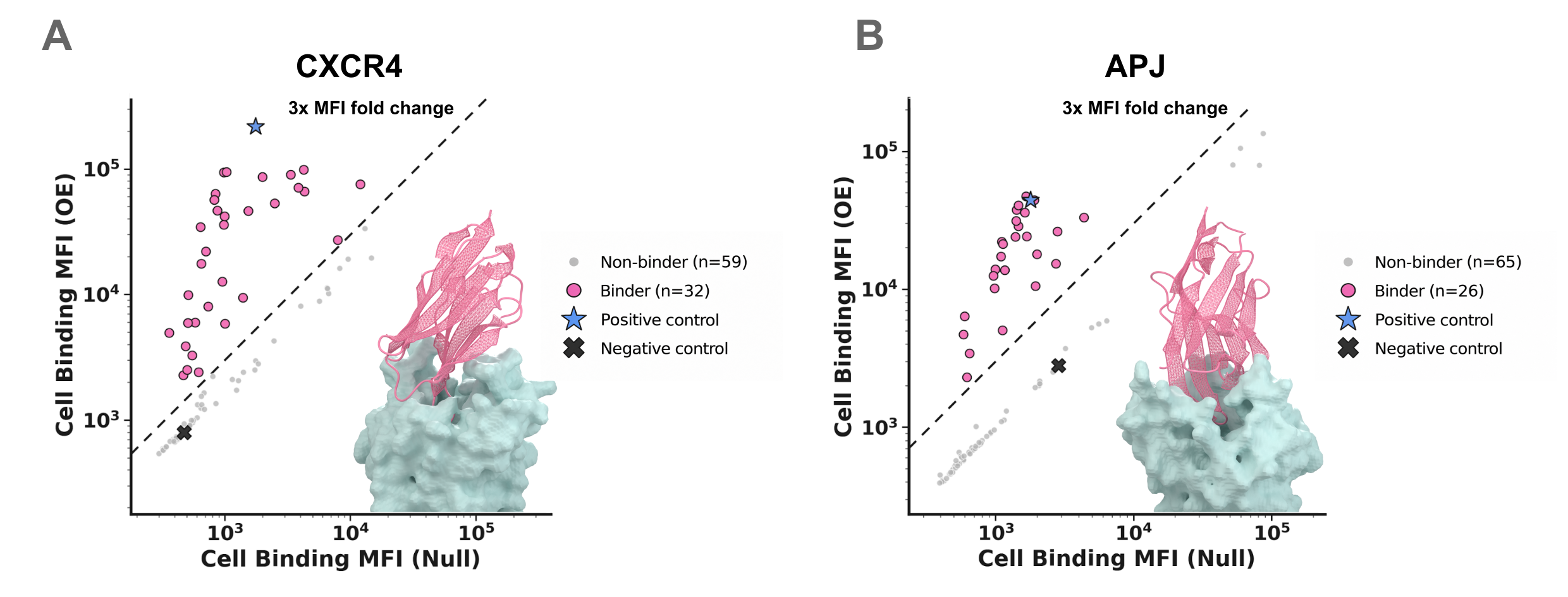
Figure 2: X-Design generated VHH sequences against CXCR4, a chemokine receptor overexpressed on tumor cells and implicated in metastasis and immune evasion, and the Apelin receptor, APJ, a class A GPCR relevant to cardiovascular and metabolic disease. To mirror therapeutic scenarios where we want a diverse panel of binders, we designed a full plate of structurally-diverse VHH to each target (91 designs). We produced the antibodies in bivalent Fc format followed by flow-cytometry against target-overexpressing cells and null-cells as control. Hits were determined as greater than a threefold signal shift in receptor-expressing cells over a null-cell control. X-Design produced hits with high hit rates in both campaigns: 32 of 91 screened VHH designs against CXCR4 (A, 35% hit rate) and 26 of 91 against APJ (B, 29% hit rate) bound target-overexpressing cells above background. The best VHHs to CXCR4 and APJ have EC50s comparable to the corresponding positive controls: 12.8 nM for CXCR4 (vs positive control 8.6 nM) and 8.4 nm to APJ (vs positive control 8.8 nM).
Given our conviction around XA-4 as a therapeutic target, at the same time as we were advancing our AI models we used conventional methods to attempt to obtain binders that might function at the very least as tools to assess the molecular landscape of the target. We ran two campaigns of a conventional naive VHH library screen against the target, with four rounds of selection, which produced some putative hits that enriched in the library but failed to bind when clonally produced (Figure 3A). We also ran a llama immunization campaign against the target, which also yielded no functional binders. These results underscore that XA-4 is not readily druggable by conventional means.
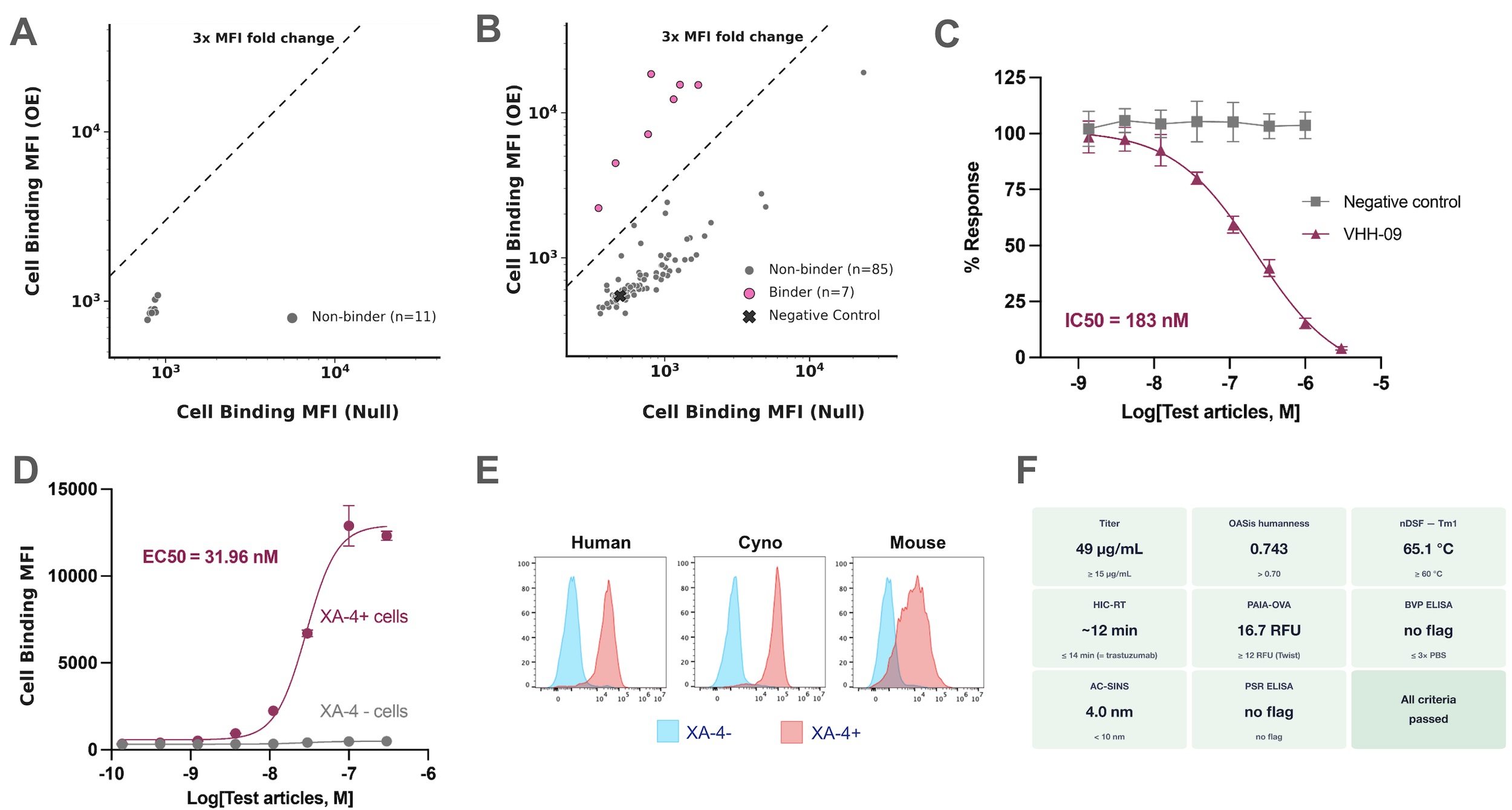
Figure 3: X-Design enables VHH discovery of an “undruggable” GPCR, XA-4. Campaigns of traditional VHH engineering approaches fail to yield binders to XA-4 (A). X-Design simultaneously explores several epitopes and structural conformations in a 60k library of designs screened against XA-4. We selected 92 of the identified enriched molecules and identified 7 binders by flow-cytometry against target-overexpressing cells (greater than a 3-fold signal shift in receptor-expressing cells over a null-cell control) (B). The best of these molecules expressed in VHH-Fc format demonstrates complete antagonism in a β-arrestin assay with an IC50 of 183 nM (C), binds to human antigen+ cells with an EC50 of 32 nM (D), is cross reactive to cynomolgus and mouse homologs (E) and passes all developability and humanness criteria (F), making it a progressable binder.
We set out to design VHHs against the same target through de novo design with X-Design Vega. Since the functional epitope and structure were not clear, we modeled conformational flexibility across multiple target candidate epitopes. After interrogating the target with designed minibinders, we used Vega to design a library of 60,000 VHHs – an approach that enabled us to evaluate multiple conformations and epitopes in a single design campaign and experiment. We screened the library by panning against the target displayed in nanodiscs, then ranked candidates for hit-calling using an enrichment model across selection rounds. We selected 92 of the identified hits and verified binding by flow-cytometry against target-overexpressing cells (greater than a 3-fold signal shift in receptor-expressing cells over a null-cell control). We then assessed functional activity in a β-arrestin reporter assay against the natural ligand identifying 6 confirmed inhibitors.The best candidate reached >96% maximum inhibition at a potency of 183 nM (Figure 3C).
This lead molecule, which selectively binds human antigen+ cells with an EC50 of 32 nM (Figure 3D), exhibits cross-reactivity with mouse and Cynomolgus homologs (Figure 3E), and has a clean developability profile (as assessed in PAIA-OVA/CEX/HEP, BVP and thermal stability assays, and a high OASis humanness score (Figure 3F)). It has now proceeded to the lead optimization phase.
The Potential of X-Design
XA-1 and XA-4 illustrate the utility of de novo design, compressing months of optimization into a single pass for structured targets, while successfully unlocking intractable targets where conventional discovery methods previously failed.
On XA-1, X-Design leveraged a known epitope and structure and designed a progressable binder in three weeks and then a lead molecule in an additional four weeks, avoiding months of hit-to-lead work and humanization often required by traditional approaches.
On XA-4, a target with extensive post-translational modifications and unclear epitopes, and where conventional library screening and immunization previously failed, X-Design was able to produce a confirmed, cross-reactive, developable antagonist.
Taken together, these two campaigns illustrate how X-Design’s de novo design capabilities are compressing months of hit-to-lead work on a well-characterized target and succeeding where conventional discovery had already failed outright on an undruggable target. Internally, the Vega class of X-Design models is unlocking our clinical pipeline. Because of X-Design, our pipeline can be driven by the therapeutic potential and biological understanding of our targets, rather than by the tractability of the targets to traditional antibody discovery approaches. Having progressable antibodies to these two active programs does not, of course, guarantee their ultimate success, but they illustrate the ability of de novo design to deliver functional, progressable binders against a broad spectrum of targets, helping to enable and expedite the design of a new generation of medicines.
X-Design Team Contributors
Aaron Jaech, Aarron Willingham, Aisha Chow, Ajay Menon, Alessandra Castiglioni, Alex Coca, Andy Deng, Anna Lauko, Avani Nandini, Brian Koepnick, Buwei Huang, Colin Zamecnik, Deborah Law, Deniz Simsek Buck, Dhirender Negi, Ellen Visscher, Elyse Fischer, Emile Mathieu, Flaviu Vadan, Frances Welsh, Frank Lee, Greg Mitchell, Guillaume Huguet, Hao Shen, Haoyang Zeng, Henry Nguyen, Hetu Kamichetty*, Hiroyasu Konno, Hsiang-Ching Chung, Joseph Watson, John Wang, Judy Mak, Justas Dauparas, Justin Yan, Kaelan Donatella, Ken Jean-Baptiste, Krishna Sirumalla, Nate Bennett, Philip Leung, Ritvik Mishra, Sandra Sisko, Shoji Maeda, Sally Shi, Steven Wilson, Tileli Amimeur, Tina Thai, Tor Erlend Fjelde, William Galvin, William Voje, Zimple Matharu.
*Corresponding author: hetu@xaira.com