X-Scientist: A Recursive Self-Improving Agentic AI Platform for Drug Discovery
Summary
We introduce X-Scientist, Xaira’s agentic AI platform for drug discovery and design. X-Scientist brings together frontier language models, biological tools, Xaira’s internal datasets, and our proprietary models to support research spanning mechanistic investigation, target identification, therapeutic design, and analysis and experimental planning.
X-Scientist serves as an AI co-scientist across the full scope of drug discovery, working alongside researchers to investigate complex questions, execute computational workflows, and refine scientific understanding as new evidence emerges. By connecting these capabilities with experimental research, X-Scientist helps translate Xaira’s advances in AI and biology into therapeutic programs, advancing our mission to discover and develop new medicines for patients.
We evaluated the X-Scientist harness on public scientific benchmarks. On DrugDiscoveryBench [1] and the life sciences subset of Terminal-Bench-Science 0.1 [2], X-Scientist outperformed other tested configurations. We experimentally tested X-Scientist-nominated genetic perturbations in TGF-β–treated liver cells, achieving a hit rate comparable to human curation and identifying perturbations of both canonical and non-canonical genes that reversed the TGF-β response, with nominations generated approximately 10× faster than human curation. These results provide initial evidence that X-Scientist can perform complex scientific tasks, integrate specialized biological models into target discovery research, and accelerate the pace of discovery.
The next phase of X-Scientist is to connect scientific reasoning with automated experimentation. By linking proposed experiments to lab execution and feeding results back into the system, we aim to build a continuous cycle of hypothesis, experiment, and analysis. Each result will inform what to investigate next, and scientists will guide the decisions that most need their expertise. We’ll share more soon about X-Automate, our AI robotics platform, and how we’re connecting it with X-Scientist to bring this cycle into the lab.
1. Building around Xaira’s science
Large language models (LLMs) are already contributing to protein design and experimentally tested biological discoveries [3, 4, 5]. Applying these capabilities to drug discovery requires a harness – a system that connects LLMs to the practical work of science. The harness lets LLMs call software tools and programs and work on a task for increasingly long periods without human intervention.
Our design principle is to build the X-Scientist harness around three components that Xaira can develop and continually improve:
- Domain-specific tools and models, including our AI models X-Cell (for target identification) and X-Design (for molecular design), built on our internal data and biological expertise.
- Adaptive research workflows that encode how we break down scientific questions, coordinate tools and analyses, interpret findings, and revise the plan as evidence emerges.
- Rigorous and thorough verifications that define how we challenge assumptions, evaluate results, and determine whether the evidence is sufficient to support the next scientific decision.
2. How X-Scientist organizes scientific work
X-Scientist is a multi-agent harness that separates coordination and verification from task execution. A lead agent directs the investigation, delegates tasks, and evaluates the evidence returned by persistent worker agents. Workers use data, tools, compute, and scientific models to produce findings with supporting evidence. A dynamic task graph records the evolving plan and dependencies and serves as working memory to guide subsequent steps as new findings emerge. (Figure 1)
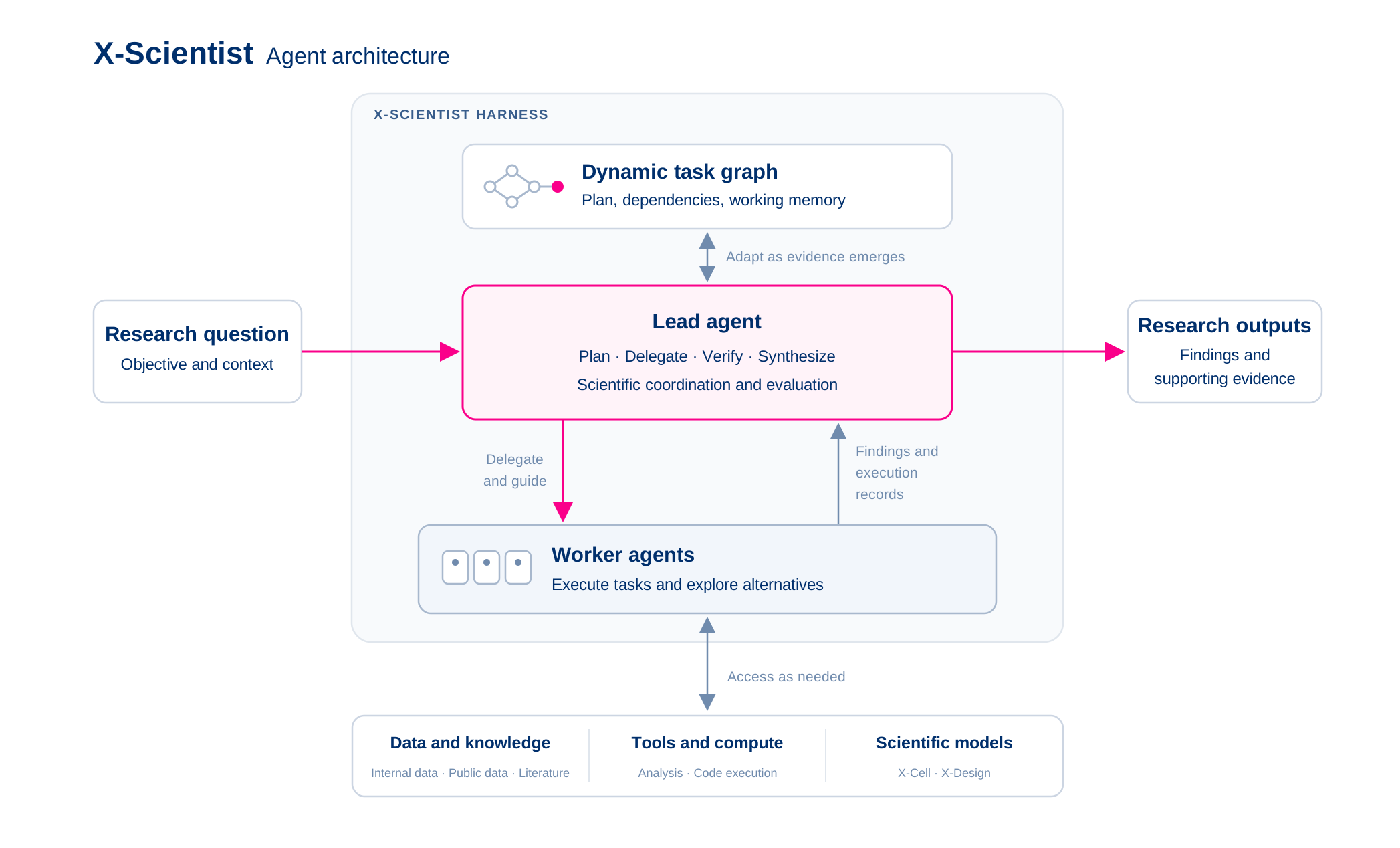
Figure 1. X-Scientist agent architecture. Research questions progress through an iterative cycle of planning, execution, and verification, supported by data, tools, and scientific models.
2.1 Domain tools and models: bringing Xaira’s capabilities into investigations
X-Scientist combines a broad range of custom bioinformatics and scientific analysis tools with Xaira’s proprietary data and internal models, including X-Cell (]target identification), X-Design (molecular design), and X-Patient (patient stratification). APIs and Model Context Protocol (MCP) servers connect these resources to the harness, allowing agents to combine established scientific methods with Xaira’s specialized capabilities within the same investigation.
Integrating our internal models requires more than making predictions available. A tailored interpretation layer for each model captures what its outputs represent, how biological and experimental context affects their meaning, and which conclusions they support.
2.2 Agent execution graphs: encoding and refining the research strategy
X-Scientist incorporates dynamic task graphs that evolve with the scientific task and evidence. The lead agent constructs an initial graph with stages suited to the research question and delegates execution to a worker. The worker maintains the graph and consults the lead after each stage, sharing findings and the current graph state. The lead agent then decides whether to continue, explore alternatives with additional agents, or revise the remaining work.
Separating coordination from execution makes the scientific decisions within this process an explicit target for improvement. We retain completed graphs to examine which strategies yielded useful evidence and where effort failed to resolve uncertainty. These records let us study and refine how the lead selects analyses, allocates effort, and requests verification while holding task execution capabilities fixed.
2.3 Verification: making scientific standards explicit
For each task, X-Scientist uses explicitly defined evaluation criteria. When multiple independent agentic workers are deployed to attempt a task, the lead agent balances their execution records against a compendium of options, allowing X-Scientist to comprehensively search through and select the most performant analysis.
This approach draws on research into language models as judges and verifiers of completed agent trajectories [6, 7]. Generating multiple candidates creates opportunities to find a correct answer, but improving the reliability of the final result also requires recognizing which candidate the evidence supports. Unlike for coding and math, verification is especially challenging for drug discovery and design tasks, but making these criteria explicit in X-Scientist provides a foundation to build on top of as capabilities and experience accumulate.
3. Evaluating X-Scientist
We evaluated X-Scientist on two complementary benchmarks. DrugDiscoveryBench comprises 82 tasks spanning target identification and validation, hit identification, analysis of structure and activity relationships, and lead optimization [8]. Terminal-Bench-Science evaluates agents on scientific research workflows using task specific verification tests [9]; we used the life sciences subset of version 0.1. Together, these benchmarks assess computational capabilities relevant to drug discovery and broader life sciences research.
We evaluated the harness without domain specific tools or skills. Within each evaluation, lead and worker agents used the same model and reasoning effort. On both benchmarks, X-Scientist used a best of three verification procedures. X-Scientist consistently improved performance over comparison harnesses using the same model and reasoning effort:
- DrugDiscoveryBench, with GPT-6-Astra at maximum reasoning effort in all three harnesses: X-Scientist outperformed Codex by 7.4 percentage points and mini-SWE-agent by 4.1 points.
- DrugDiscoveryBench, with Claude Sonnet 5 at maximum effort in both harnesses: X-Scientist outperformed Claude Code by 13.4 points (Figure 2a).
- Terminal-Bench-Science 0.1, life sciences subset, GPT-6-Astra in both harnesses: X-Scientist outperformed Codex by 7.1 points at maximum effort and 3.5 points at low effort (Figure 2b).
X-Scientist also held its advantage in a cross-model comparison. Using Claude Sonnet 5, it scored 58.1% on DrugDiscoveryBench, 4.4 percentage points above Claude Code using Claude Opus 5, with both models at maximum effort.
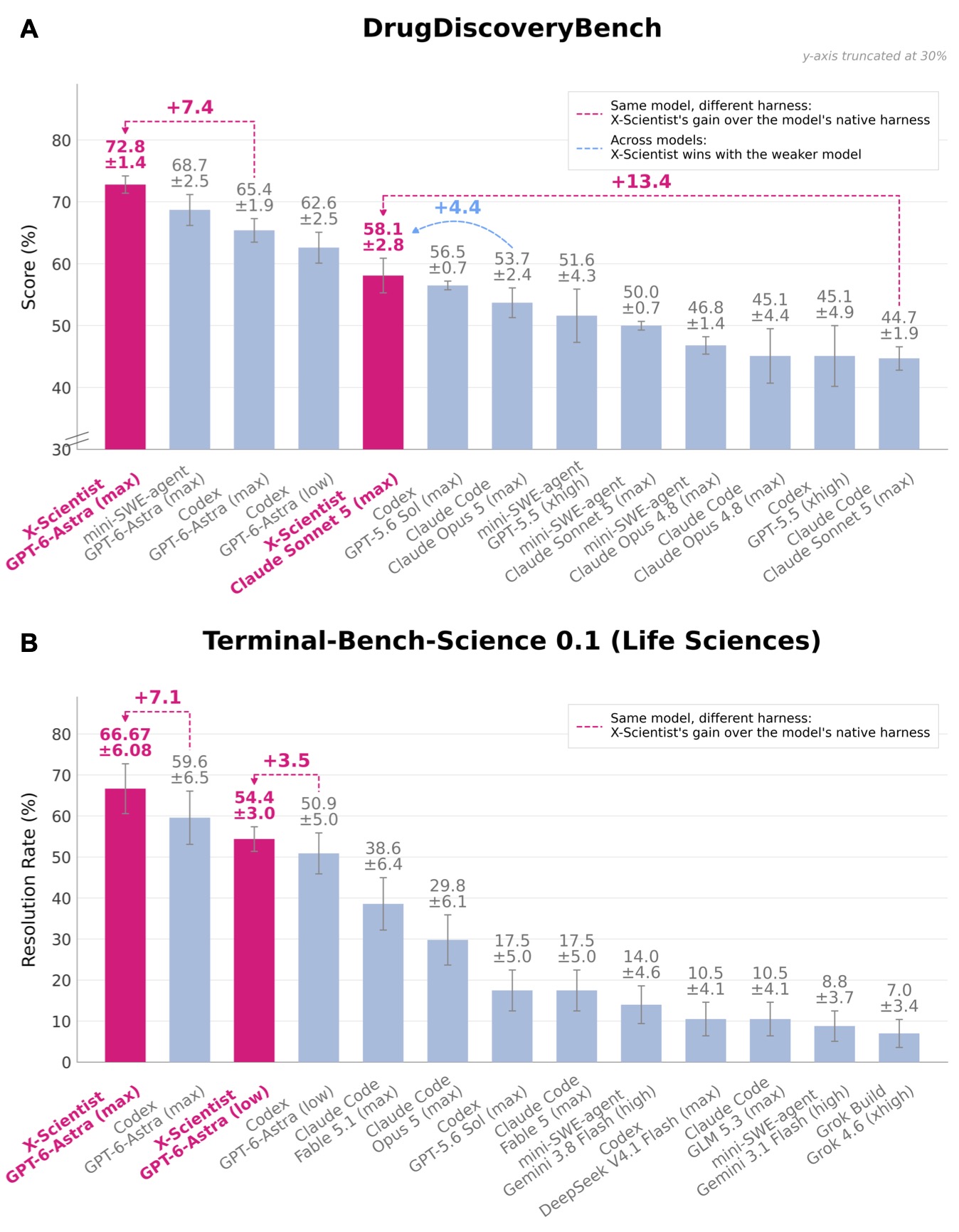
Figure 2. X-Scientist harness evaluated on two public benchmarks. (a) DrugDiscoveryBench scores. (b) Resolution rates on the life sciences subset of Terminal-Bench-Science 0.1. Magenta bars denote X-Scientist; blue bars denote comparison harnesses. Annotations report improvements in percentage points.
X-Scientist nominates targets that reverse TGF-β signaling in liver cells
As a proof of concept for X-Scientist-driven biology discovery, we experimentally tested genetic perturbations nominated by X-Scientist under twelve different disease relevant chemical exposures in hepatic liver cells (HepG2). One of the exposures, TGF-β signaling, regulates tissue repair, cell growth, and differentiation throughout the body, while its dysregulation can promote cancer progression. It is also a key driver of fibrosis and disease progression in chronic liver disease. In this context, we assessed whether X-Scientist, powered by Xaira’s full intelligence stack, could identify genetic interventions that reverse a TGF-β–induced cellular phenotype.
To evaluate X-Scientist’s ability to identify such perturbations, we compared its nominations with those selected through human scientist curation or at random from expressed genes (n = 381, 321, and 433 perturbations, respectively). We experimentally evaluated the nominations by Perturb-seq in the wet-lab, and scored each perturbation by how far it shifts the gene-expression profile of TGF-β-treated cells toward the untreated state. Using a low-dimensional embedding of these profiles, we computed a TGF-β inactivation score, scaled such that 0 represents TGF-β-treated cells and 1 represents untreated controls. Perturbations with a reversal z-score ≥ 3 were classified as hits. X-Scientist achieved a hit rate of 7.1%, compared with 6.9% for human-curated genetic perturbations and 0.9% for randomly selected ones (Figure 3a). Thus, X-Scientist identified effective perturbations at a rate comparable to human scientist curation, while generating its nominations approximately 10x faster (Figure 3b).
More interesting than speed alone, X-Scientist was significantly better at identifying non-obvious candidates than human curation. Experimentally confirmed hits from the X-Scientist library identified both canonical TGF-β pathway genes in the wet-lab, including the positive controls TGFBR1, TGFBR2, SMAD3, and SMAD4, and non-canonical genes outside the core pathway (Figure 3c). Canonical hits generally produced stronger TGF-β dampening effects, but non-canonical hits also shifted cells towards the untreated state, with three exceeding the median TGF-β inactivation score of the canonical hits (Figure 3d). None of these three were represented in the human-curated library, suggesting that X-Scientist can complement expert curation by uncovering less obvious biological relationships. Together, these results demonstrate that X-Scientist can identify effective genetic perturbations in a defined cellular context, achieving a hit rate comparable to human curation while identifying hits beyond the canonical pathway.
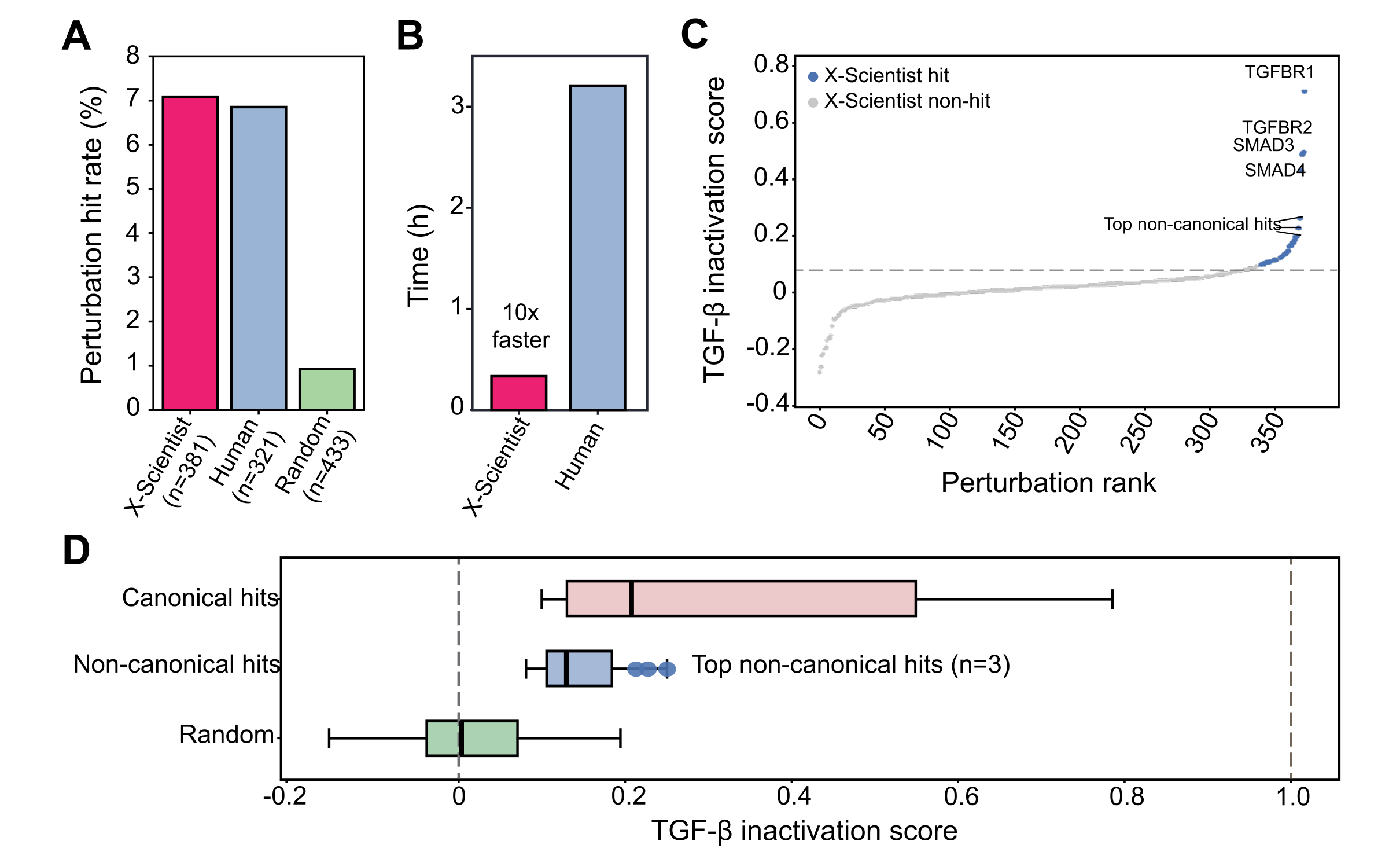
Figure 3. X-Scientist identifies canonical and non-canonical TGF-β reversal targets. (a) Perturbation hit rate in the X-Scientist (n=381), human-curated (n=321), and random (n=433) libraries. Each perturbation was measured in ≥30 cells. (b) Time to nominate targets using X-Scientist (20 minutes) versus human scientist curation (>3 hours). (c) TGF-β inactivation scores for the X-Scientist library, ranked from lowest to highest. Negative scores indicate a shift further into the TGF-β state, and scores above 1 indicate a shift beyond the untreated state. Top canonical (TGFBR1, TGFBR2, SMAD3, and SMAD4) pathway genes are labeled. Top non-canonical hits are defined as non-canonical hits that exceed the median TGF-β inactivation score of canonical hits. (d) TGF-β inactivation scores for canonical X-Scientist hits, non-canonical X-Scientist hits, and the random library. 50 perturbations were randomly selected from the random library for plotting. Boxes show the group median TGF-β inactivation score and IQR, and whiskers show the full range. Dashed lines mark TGF-β-treated (0) and untreated (1) control cells. Perturbation hits were categorized as canonical or non-canonical by membership in the Reactome gene set: “Signaling by TGF beta Receptor Complex.”
5. Toward a Recursively Self-Improving X-Scientist
A further capability of X-Scientist is autonomous research: designing computational experiments, building models, evaluating their results, and using the resultant evidence to determine what to investigate next. A key enabler is model–harness co-evolution through asynchronous execution: model experimentation and refinement of the research procedures that guide experiment selection and execution can advance without waiting for either process to finish. This allows X-Scientist to dynamically refine both models and the harness as evidence accumulates, with versioned harness updates guiding subsequent experiments while preserving the configuration of ongoing runs.
In an initial pilot study (Figure 4), we evaluated X-Scientist against AutoScientists [10] and AutoResearch [11] on PerturbQA [12], which involves predicting gene-expression responses to genetic perturbations. Each system received a four-hour research allowance and a $100 API budget cap. X-Scientist achieved the highest best-so-far validation AUROC among the evaluated systems: 0.6789, compared with 0.6728 for AutoScientists and 0.6441 for AutoResearch. Its estimated API expenditure was $30.52, versus $93.27 for AutoScientists and $18.75 for AutoResearch. Within this pilot, X-Scientist achieved higher validation performance with approximately 67% lower estimated API cost than AutoScientists. It maintained a single-agent workflow throughout the run, illustrating that a lightweight research configuration can achieve competitive validation performance without the overhead of a larger agent team.
Building on these initial results, we are continuing to enable X-Scientist to pursue longer and deeper sustained, autonomous scientific investigations, learning from experimental feedback, refining research strategies, and advancing from an initial question toward experimentally testable discoveries.
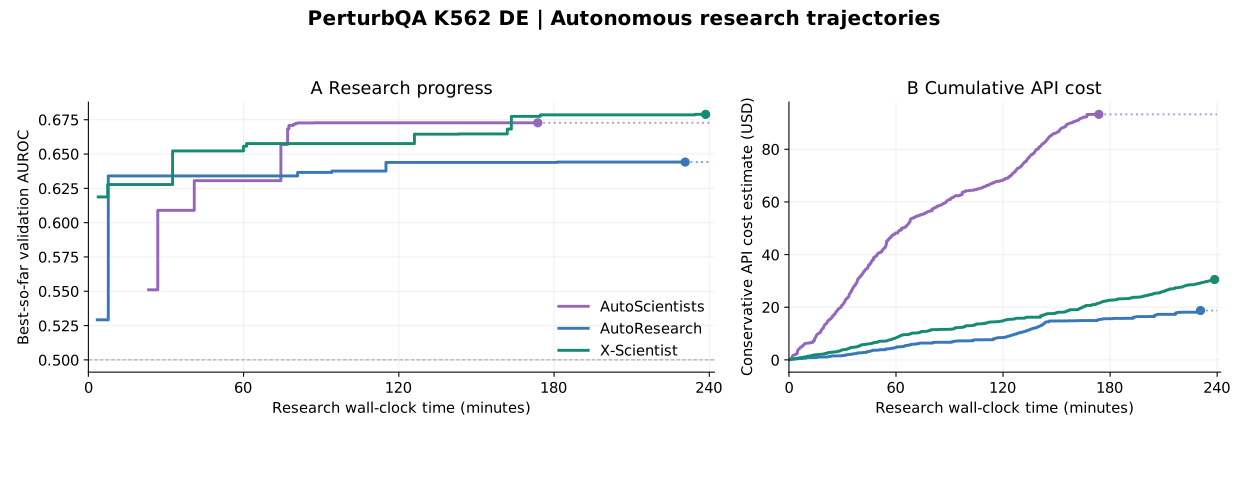
Figure 4. Autonomous Research Progress and API cost on PerturbQA. (A) Best-so-far validation AUROC. (B) cumulative estimated API cost under a four-hour allowance and a $100 API budget cap. In this comparison, X-Scientist achieved the highest validation AUROC with approximately 67% lower API cost than AutoScientists; dotted extensions carry forward results after termination.
The future of X-Scientist: a Virtual Drug Hunter
Building a true virtual drug hunter requires more than solving individual scientific tasks. It requires a system that can connect evidence across an investigation, recognize what remains uncertain, and determine which experiments would most effectively advance the work. X-Scientist provides the foundation for this vision, bringing scientific coordination, verification, and specialized capabilities into a platform designed to grow with Xaira’s research.The next step is to build on these results toward a continuous discovery loop. The liver-cell experiments described above demonstrate an initial pass: X-Scientist nominated genetic perturbations, and wet-lab testing identified both canonical and non-canonical targets that reversed the TGF-β response. Feeding these experimental results back into models such as X-Cell and the agent’s research strategies would close the loop and guide the next round of experiments.
This approach could be especially valuable for questions such as combinatorial target discovery, where the number of possible combinations makes exhaustive testing in the lab impractical. Virtual experiments could help prioritize promising combinations for laboratory testing, with each round of experimental feedback refining subsequent predictions. With scientists guiding research priorities and interpreting key findings, each cycle would deepen our understanding of biology and improve our ability to choose informative experiments.
Connecting this loop to automated experimentation will allow scientific reasoning and lab execution to advance together. In a companion post, we introduce X-Automate, our AI robotics platform, and describe how we are connecting it with X-Scientist to accelerate the cycle from experimental planning to execution and learning.
Our ambition is to build a virtual drug hunter that expands what scientists can investigate and makes each investigation a foundation for the next, accelerating the path from biological insight to new medicines.
X-Scientist Contributors
Adam Litterman, Ann Huang, Avani Nandini, Bo Wang*, Brian Fox, Ci Chu*, Dan Gulbranson, David Nusinow, Haotian Cui, Matthew Wilken, Neal Ravindra, Shihao Ma, Sukwon Yun, Tom Crevier, Xinyue Rui
*Corresponding authors: bo.wang@xaira.com, ci.chu@xaira.com
References:
1. Scale AI. (n.d.). DrugDiscoveryBench. https://labs.scale.com/leaderboard/drugdiscoverybench
2. Dillmann, S. (2026). Terminal-Bench-Science 0.1. https://www.terminal-bench-science.ai/announcement
3. Anthropic. (2026). How Claude is accelerating protein design and analytical chemistry. https://www.anthropic.com/research/Claude-accelerates-protein-design
4. Gottweis, J., Weng, W.-H., Daryin, A., Tu, T., Sirkovic, P., Myaskovsky, A., Glowaty, G., Weissenberger, F., Orlandi, A., Popovici, D., Palepu, A., Rong, K., Tanno, R., Saab, K., Zhang, F., Blum, J., Carroll, A., Kulkarni, K., Tomašev, N., Zverinski, D., Rendulic, I., Vedadi, E., Hasler, F., Rimanic, L., Boia, M., Budiselic, I., Feinstein, B., Bellaiche, M., Sheffer, T., Freyberg, J., Ratcliff, J., Bertolli, O., Chou, K., Hassidim, A., Gokturk, B., Vahdat, A., Guan, Y., Dhillon, V., Vaishnav, E. D., Lee, B., Costa, T. R. D., Penadés, J. R., Peltz, G., Matias, Y., Manyika, J., Hassabis, D., Xu, Y., Kohli, P., Pawlosky, A., Karthikesalingam, A., & Natarajan, V. (2026). Accelerating scientific discovery with Co-Scientist. Nature, 655, 487 to 496. https://doi.org/10.1038/s41586-026-10644-y
5. Ghareeb, A. E., Chang, B., Mitchener, L., Yiu, A., Szostkiewicz, C. J., Shved, D., Gyimesi, G. J., Laurent, J. M., Wright, S. M., Razzak, M. T., White, A. D., Finnemann, S. C., Hinks, M. M., & Rodriques, S. G. (2026). A multi-agent system for automating scientific discovery. Nature, 655, 497 to 505. https://doi.org/10.1038/s41586-026-10652-y
6. Zhang, A., & Khattab, O. (2026). Language model harnesses are compositional generalizers. https://alexzhang13.github.io/blog/2026/harness/
7. Sakana AI. (2026). Learning to Orchestrate Agents in Natural Language with the Conductor. https://sakana.ai/learning-to-orchestrate/
8. Zheng, L., Chiang, W.-L., Sheng, Y., Zhuang, S., Wu, Z., Zhuang, Y., Lin, Z., Li, Z., Li, D., Xing, E. P., Zhang, H., Gonzalez, J. E., & Stoica, I. (2023). Judging LLM-as-a-Judge with MT-Bench and Chatbot Arena. arXiv 2306.05685. https://doi.org/10.48550/arXiv.2306.05685
9. Kwok, J., Li, S., Atreya, P., Liu, Y., Jiang, Y., Finn, C., Pavone, M., Stoica, I., & Mirhoseini, A. (2026). LLM-as-a-Verifier: A General-Purpose Verification Framework. arXiv 2607.05391. https://doi.org/10.48550/arXiv.2607.05391
10. Gao, S., Fang, A., & Zitnik, M. (2026). AutoScientists: Self-Organizing Agent Teams for Long-Running Scientific Experimentation. arXiv 2605.28655. https://arxiv.org/abs/2605.28655
11. Karpathy, A. (2026). Autoresearch: AI agents running research on single-GPU nanochat training automatically. GitHub repository. https://github.com/karpathy/autoresearch
12. Wu, M., Littman, R., Levine, J., Qiu, L., Biancalani, T., Richmond, D., & Huetter, J.-C. (2025). Contextualizing biological perturbation experiments through language. arXiv 2502.21290. https://arxiv.org/abs/2502.21290