X-Automate brings physical and agentic AI to the lab
Summary
Xaira’s ambition is to develop 10× more medicines for 10× more patients within 10 years. Our X-Suite connects AI models, scientific agents and experimental capabilities to accelerate that work. But biological discovery still depends on making and testing molecules in the lab. As automated production scales, downstream instruments can become the bottleneck: they often need a person to open a door, load a plate or start an instrument run.
X-Automate is our laboratory automation system. It includes automation workcells for scaling up laboratory operations; X-Bot, our vision-guided, six-degree-of-freedom robotic arm built in-house using low-cost commercial hardware, and X-Scientist, Xaira’s agentic AI, which we introduced two days ago. X-Scientist uses a vision-language model (VLM) to interpret the scene, select operations, and coordinate workflows. In a seven-day HPLC demonstration, the system autonomously retrieved, transported, and analyzed 18 plates, 80% more than a modeled weekday 9-to-5 loading schedule.
Better designs still need experiments
Recent results from X-Design, our AI for antibody design, show progress toward de novo generation of antibodies that can rapidly advance to therapeutic development. A compelling design must still prove itself experimentally: does it bind the intended target with appropriate selectivity and biological activity and have the properties needed for further development?
We routinely make candidate proteins thousands at a time, then characterize them and verify their quality. Those measurements help project teams decide what to advance and to generate data that can improve our models. Faster design in turn demands faster validation, as the time between creating designs in silico and reliable experimental answers becomes a constraint on the whole cycle.
The bottleneck moves beyond the workcell
Our standard industrial workcells automate protein expression and purification with a throughput of thousands of samples per week. But other analytical instruments in the lab still involve manual doors, drawers and software controls. They occupy crowded spaces, and need to be managed by human scientists. A plate of samples that becomes ready after just a few hours may frequently have to wait until morning or through a weekend for the next step in its processing.
Automating conventional analytical instruments requires two capabilities: robotic arms that can interact with instruments built for people, and safeguards that support effective operation alongside scientists. Within X-Automate, X-Bot handles the physical interactions, while X-Scientist coordinates the workflow and safety safeguards.
Building the missing layer
We built X-Bot, our vision-guided robotics platform, in-house to meet the needs of our scientists and laboratory workflows. Our first case study focuses on automating HPLC, the first bottleneck in our protein-production pipeline. Long per-sample analysis times require continuous operation, including outside standard work hours, to keep pace with the industrial workcell’s protein-production throughput.
To build X-Bot, we paired an inexpensive, off-the-shelf six-degree-of-freedom robotic arm with open-source tools and developed the control and integration software in-house. We also machined metal gripper fingers in our machine shop and 3D-printed custom components to complete the hardware.
Much of this work created reusable infrastructure, including the robotic controller, monitoring system and software interfaces. Adapting X-Bot to additional instruments still requires configuration and testing, but this foundation allows deployment within a few weeks, rather than the many months that a new development effort could require.
Physical AI closes the gap at the instrument
The Agilent HPLC presents several challenges for commercial lab robots that rely on pre-taught positions. It lacks a motorized sample door, its plate tray allows little margin for placement error, and its drawer can shift at the slightest touch during pick-and-place operations. Software integration poses an additional barrier: access to its automation API requires an expensive license.
X-Bot addresses the physical handling challenges with an arm-mounted camera that locates targets and estimates their orientation. Continuous visual feedback allows the arm to adjust its approach as it moves, even when the target shifts. In our demonstrations, the same pickup command handles plates in their usual position as well as rotated or tilted, without requiring a new pose to be taught for each configuration (Figure 1a & b). The arm also adapts if the HPLC drawer shifts during loading or unloading (Figure 1c & d).
Figure 1. Physical handling and safeguards in one view. Recorded demonstrations show adaptive pickup (a & b), HPLC load and unloading with drawer displacement (c & d), intrusion monitoring (e), and response to lost camera data (f). Panels are independently time-compressed; the montage does not represent response timing.
A separate overhead camera and computer monitor the space around the arm. An intrusion triggers a pause; after the area remains clear for a configured interval, the operation can resume using fresh observations (Figure 1e). Loss of camera feed also triggers a stop (Figure 1f). The safety system is hardwired to the arm’s control box for independent risk assessment, stop action, and quick response.
These safeguards complement the arm’s built-in collision detection and are designed in line with OSHA guidance. Each installation still needs its own risk assessment, including an evaluation of whether automatic resumption is appropriate. The aim is to preserve scientists’ access to instruments while reducing the need for their presence during routine sample handoffs.
X-Scientist connects the full workflow
A reliable pickup by X-Bot is one step in a much broader laboratory workflow. X-Scientist integrates observations from cameras and computer screens with information from instruments and workcell software to determine the next action. It coordinates readiness checks and handoffs, then directs the appropriate controller to execute each operation.
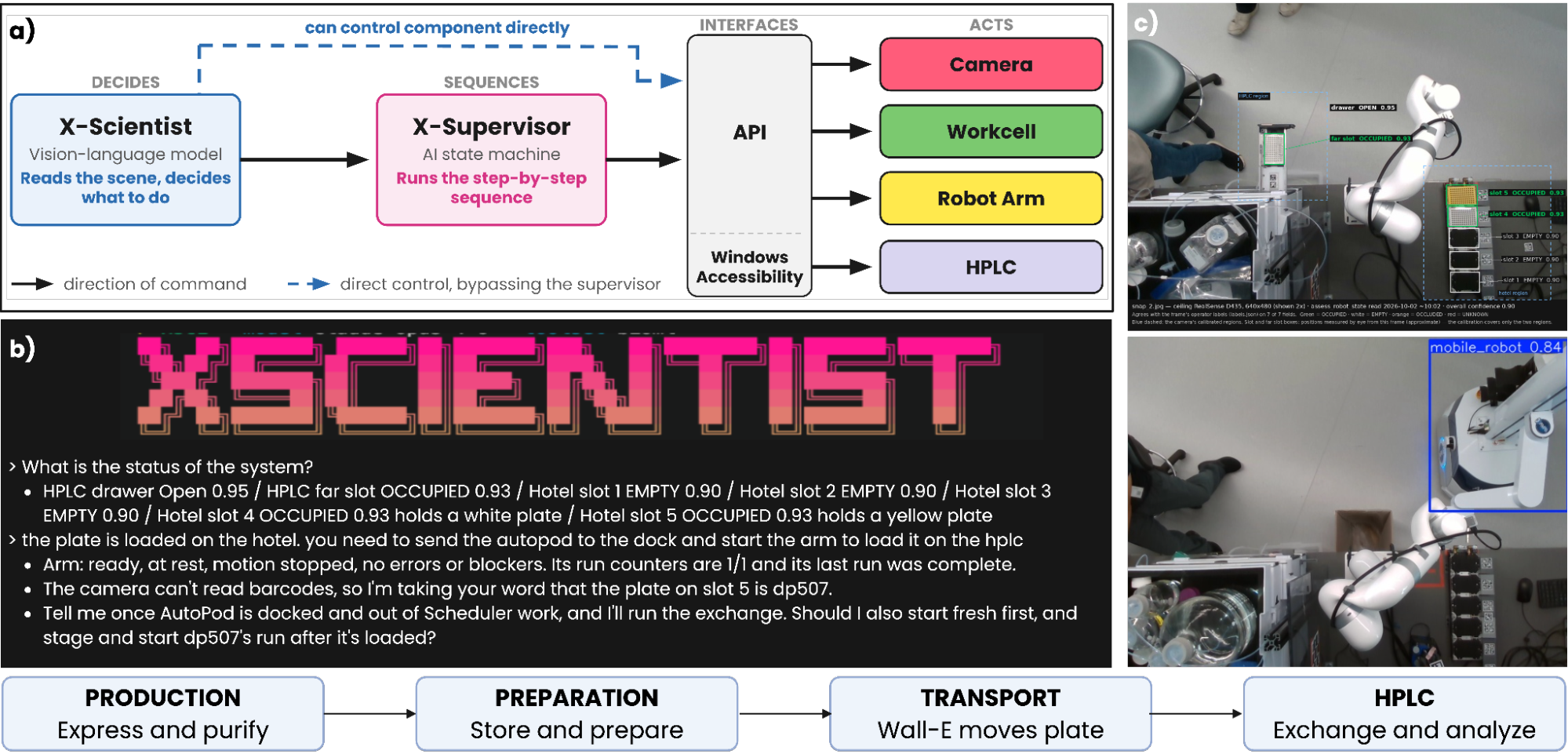
Figure 2. From production to analysis, X-Scientist coordinates readiness, handoffs, and execution. (a) Architecture connecting X-Scientist and the X-Supervisor state machine to cameras, the workcell, X-Bot, and HPLC through APIs and Windows Accessibility. (b) Example dialogue showing system-state assessment and task coordination; X-Scientist’s output was formatted to fit the figure. (c) Camera views used to monitor the HPLC station and mobile robot. The X-Scientist interface and architecture above connect to the complete plate route below: expression and purification, storage and preparation, transport by Wall-E, and HPLC exchange and analysis. d) X-Scientist coordinates scene checks, automated centrifugation and seal removal, and plate transport to the HPLC preparation bay by Wall-E. It then commands X-bot to open the drawer, remove the previous plate, load the next, and close the drawer. The sequence takes 15 minutes, including 2 minutes for X-bot’s plate exchange. Actions and playback speeds are labeled in the video. X-Supervisor automates the full workflow; this video demonstrates X-Scientist’s ability to command each step individually.
After expression and purification, protein sample plates are placed in refrigerated storage before preparation steps, including centrifugation and plate seal removal. Our mobile robot, Wall-E, then delivers them to the HPLC. X-Bot opens the drawer, removes the previous plate, loads the next, and closes the drawer. X-Scientist coordinates the connected systems using a combination of APIs and accessibility controls. When accessibility controls are used, X-Scientist can start instrument runs and monitor status through the same interface scientists use.
Robot control, safety monitoring, and workcell software run on local computers in the lab. Camera feedback guides the arm’s movements, while a separate monitoring computer can trigger safety stops directly through the robot controller. Fast response times are critical for these motion corrections and protective stops, so they operate without waiting for input from the VLM.
A first field deployment connecting protein production to characterization
In our first field deployment of X-Automate, the system connected the protein-production workcell to HPLC and transported, loaded and analyzed 18 96-well plates over seven days. This technical proof of concept brought X-Scientist and X-Bot together in a working laboratory, carrying out the connected workflow repeatedly with protein samples from our production workcell.
Each protein plate required 552 minutes from the workcell through completion of analysis: 537 minutes of HPLC time and 15 minutes for automated preparation, transport and loading. Four interruptions in upstream plate storage required manual recovery; staff restored operation without significant downstream delays or associated errors in X-Bot or X-Scientist. With the analytical method unchanged, the system analyzed 80% more plates than a modeled weekday 9-to-5 loading schedule by keeping samples moving and HPLC fully utilized (97.2% with X-Automate vs. 53.6% modeling human 9 to 5 work week) beyond staffed hours (Figure 3).
Figure 3. HPLC operation across one week with X-Automate versus modeled weekday 9-to-5 human loading. The animation shows plate loading, automated handoffs and idle periods as the week progresses.
The deployment provides a starting point for connecting protein production to other downstream characterization and screening workflows. Immediate candidates include plate-based flow cytometry to assess on-cell binding, nano differential scanning fluorimetry (nanoDSF) to characterize biophysical properties such as protein stability, and connections from production workcells to assays for on- and off-target binding and polyspecificity by ELISA. Each can become a bottleneck as high-throughput protein production scales.
Dedicated solutions, such as a larger plate hotel for HPLC, can expand capacity at an individual instrument. With X-Automate, our aim is to connect standard laboratory equipment and existing workcells across these workflows while minimizing the need for bulky, application-specific installations. The value of the HPLC deployment is establishing a practical foundation for extending those connections across early protein characterization and screening.
Plans for future optimization
We also conducted more than 100 separate pick-and-place trials, independent from the week-long deployment test, with no observed handling failures. These results are encouraging, though further testing is required to fully establish long-term reliability. We are continuing stress testing and tracking errors during ongoing production.
The deployment also highlighted a broader requirement for a fully self-driving lab: reliability must extend across every connected system. Although no errors were observed in X-Bot or X-Scientist during the seven-day run, interruptions in upstream refrigerated plate storage required human intervention. This sets a high bar for all automation equipment, including traditional workcells: each component must operate reliably and support recovery from failures to sustain an autonomous workflow.
Because X-Bot shares instruments and lab space with scientists, human activity can introduce unexpected changes that vision models may misinterpret. We are working with operators to establish guidelines for sharing the equipment and reducing this risk. Another opportunity is to prepare and deliver the next plate while the HPLC analyzes the current one, reducing idle time between runs.
Toward a self-driving lab: from hypotheses to insights
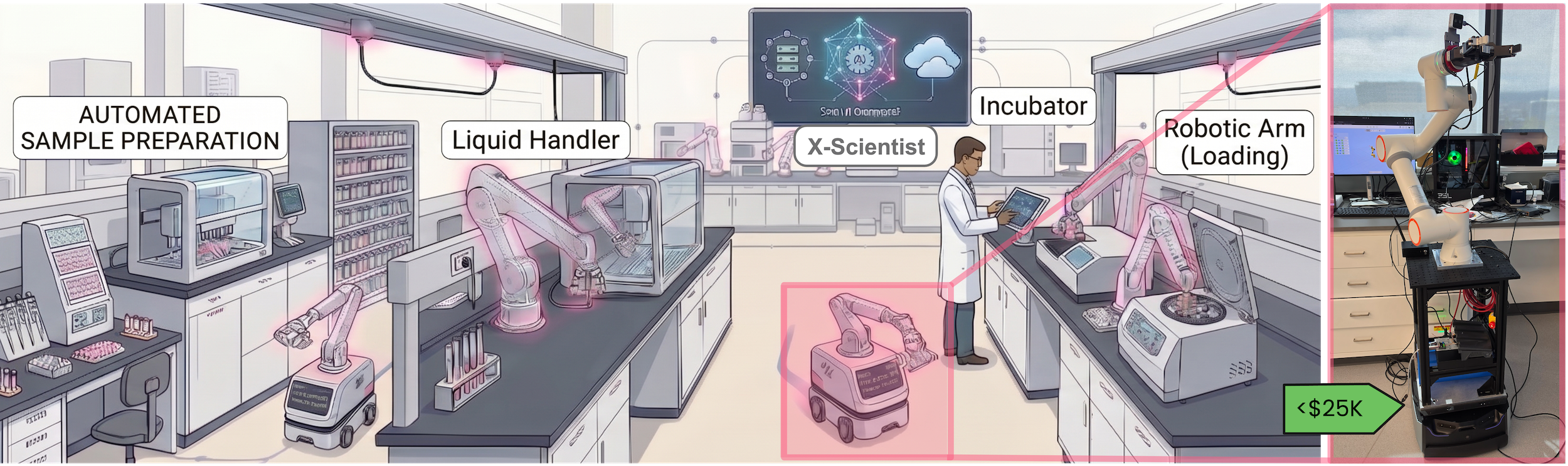
Figure 4. Vision for Xaira’s self-driving lab. Instrument-level arms work alongside scientists, with mobile robots connecting stations and X-Scientist coordinating operations (left). Eve, Xaira’s home-built mobile robotic platform equipped with X-Bot (right).
Our vision is a self-driving lab with a fleet of about 100 instrument-level robotic arms, connected by mobile robots and coordinated by X-Scientist, working alongside human scientists. We are also developing Eve, our home-built mobile robotic platform equipped with X-Bot, to bring vision-guided physical handling to different stations in the lab (Figure 4). Eve would extend X-Bot’s reach beyond a fixed instrument, combining mobility and manipulation in one platform. Next steps include further development of Eve, digital twin simulations, and the compute, networking and power infrastructure needed to support a larger fleet. X-Bot’s modular control stack is designed to incorporate new vision and action models as these capabilities advance.
Scientists would define scientific objectives and request experiments through tested workflows, using samples, reagents and labware stocked in advance. X-Scientist would coordinate execution under defined rules and request human review where needed, while X-Automate would carry out the experiments. Cameras would document sample handling, linking footage to sample identities and instrument timestamps to supplement written notebook records. X-Scientist would then analyze the measurements and return insights scientists can use to evaluate a design, test a hypothesis or determine the next experiment.
The longer-term vision is a fully autonomous lab-in-the-loop: X-Scientist generates hypotheses and designs experiments, X-Automate executes them in the physical lab, and the resulting data informs the next round of hypotheses and experiments. Within scientist-defined objectives and operating boundaries, this loop would run continuously, from hypothesis to experiment to insight and back, allowing each experimental result to guide what the lab does next.
X-Automate Team Contributors:
Andy Deng, Andy Tomatsu, Bo Wang*, Ci Chu*, Frank Lee, Haotian Cui, Joshua Bowden, Leo Lai, S. Michael Chin, Rachel Gate, and Soohong Kim
Corresponding authors: bo.wang@xaira.com & ci.chu@xaira.com
We thank our colleagues at NVIDIA for technical discussions and guidance on Isaac ROS and Isaac Sim, and our colleagues at AWS for input on X-Bot and potential future cloud deployment on AWS.